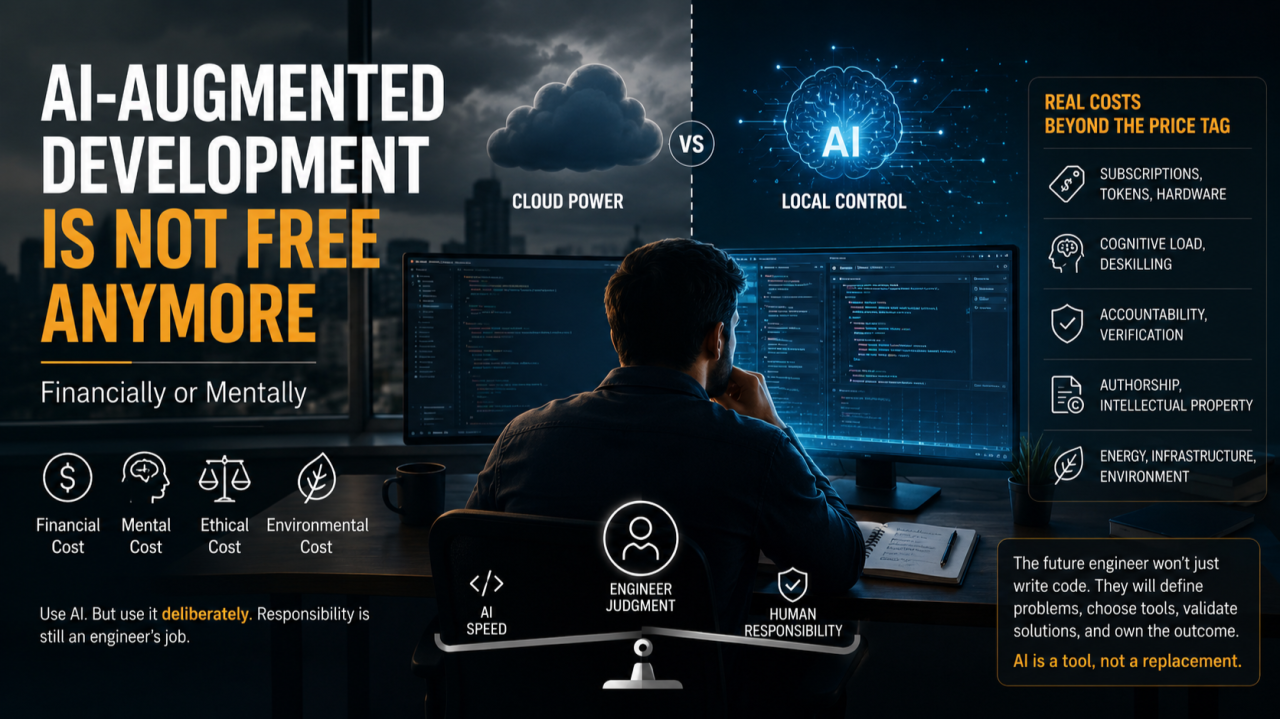
AI-Augmented Development Is Not Free Anymore
AI-assisted development has financial, mental, ethical, environmental and professional costs. The responsible engineer needs cost awareness, verification and judgment.
AI-assisted software development has entered a new phase, bringing a wave of hidden challenges.
For a while, many of us had the feeling that AI help was almost unlimited: a relatively small subscription, a coding assistant in the IDE, and the comfort of asking questions again and again without thinking too much about the cost.
That comfort is disappearing.
The more we use AI for real software engineering work - architecture, debugging, refactoring, migrations, documentation, testing, code review, and system design - the more obvious it becomes that significant reasoning has a real price.
That price is often paid in subscriptions, tokens, cloud usage, or the operational complexity of managing local models. But there is another cost that worries me even more: the mental cost.
The mental cost is the increased cognitive load and potential deskilling that arise when AI takes on the reasoning, troubleshooting, and decision-making that traditionally kept software engineers deeply engaged with their work.
The Hardware Journey: Local vs Cloud
Over the past few weeks, I started seriously investigating alternatives to cloud-based coding assistants and large LLMs. My primary motivation was practical: the rising cost of AI-augmented development. I wanted to understand whether local models could become a realistic alternative for my daily work as a software engineer and technical architect.
Very quickly, the investigation became a hardware journey.
An RTX 3060 with 12 GB VRAM can help with experiments and learning, but soon you start considering cards with more memory and even workstation-class hardware. At every step, the same lesson becomes clearer: VRAM is the real currency of local AI. Less memory means smaller models, smaller context windows, more compromises, and less useful reasoning. More memory means better possibilities, but also a much higher investment.
I looked at Apple Silicon machines with unified memory, compact AI workstations, NVIDIA-based devices, NPUs, browser-based models, and smaller local models that can run directly on client machines. Each of these options is interesting, but none of them magically removes the basic trade-off: local AI is useful, but it is not automatically a replacement for strong cloud LLMs.
- For simpler, well-scoped tasks, local models make sense: generating unit tests, simple code transformations, semantic search, intelligent copy-paste, document classification, speech-to-text with Whisper-like models, local RAG, or privacy-sensitive automation.
- For serious reasoning - architecture-level decisions, complex debugging, large-context analysis, and high-quality software engineering assistance - the best cloud models are still difficult to replace.
At some point, the question stops being technical and becomes economic. If I invest several thousand euros into local AI hardware, will it really pay back? For client demos, on-premise AI, private document processing, semantic search, transcription, or specialized local workflows, the value can be real. But for replacing a strong cloud coding assistant in architecture-heavy development, the answer is much less obvious.
What Happens to Our Thinking?
This brings us to a more uncomfortable question: what happens to our thinking?
I can now develop much faster with AI. I can review generated code, improve it, refactor it, test it, and integrate it into a larger architecture. But reviewing code is not the same mental exercise as writing it from scratch.
The daily struggle with logic, edge cases, dependencies, broken builds, unclear documentation, and difficult debugging is part of what made many of us strong engineers. If AI removes too much of that resistance, we risk losing the mental resilience and deep problem-solving skills honed by tackling difficult technical challenges without assistance.
This concern is not only personal. Recent empirical research on professional software engineers suggests that AI coding assistants are fundamentally changing the nature of engineering work itself, improving feedback loops while also affecting flow state and cognitive load. Vella and Blincoe describe a productivity-experience paradox: while developers' perception of overall productivity remained high, the proportion of engineers reporting a worsened developer experience in terms of mental effort and focus nearly doubled over time.
My father could drive without GPS. Today, many people cannot imagine driving without it. GPS did not make transportation worse; it changed what people do every day. Maybe software development is going through a similar transition.
Maybe the future engineer will not be the person who writes every line of code by hand. Maybe the future engineer will be the person who can clearly define the problem, choose the right tools, validate the output, understand the architecture, control the risks, and recognize when AI is wrong.
Accountability and Discipline
AI is powerful, but it is not perfect. It can hallucinate. It can invent facts. It can misunderstand requirements. It can generate code that looks correct but fails in edge cases.
AI hallucinations are not just technical bugs; they can become a source of plausible yet false information, making human verification part of professional accountability. Because these systems function on next-token probability mapping rather than factual comprehension, they lack the intentional awareness to recognize or prevent their own fabrications.
The credibility problem is not theoretical: even in expert environments, AI-generated or fabricated citations can go undetected when verification is not systematic. Security leaders are also raising concerns that AI-generated software can blindly replicate flawed or outdated coding patterns, making systematic governance and rigorous manual code review even more important.
For software engineers, this matters. If I deliver code, architecture, documentation, or analysis with AI support, the responsibility is still mine. I cannot say to a client, a team, or a production system: the AI told me so.
That is not engineering. AI can accelerate thinking, but it cannot replace accountability.
In that sense, AI does not remove the need for engineering discipline. It increases the need for it because the output can look polished even when it is wrong.
The Ethical and Environmental Costs
There is also a cost of authorship and intellectual property. Many AI systems are trained on enormous amounts of human-created content.
The copyright question is unresolved. The European Parliament Think Tank notes that general-purpose AI training may involve copyrighted materials and that legal uncertainty remains despite existing EU copyright and AI rules. A broader European Parliament study warns that generative AI poses structural risks to creativity and fair remuneration if authorship and training practices are not managed responsibly.
As software engineers, we are used to respecting licenses. We care whether a library is MIT, Apache, GPL, or proprietary. So why should training data be treated as if it had no owner, no author, and no history? We should avoid using AI to blindly copy proprietary code or bypass creators' economic rights. The question is not only: can AI generate this? The better question is: should I generate this, and do I understand what human work may stand behind it?
Beyond ethics, we cannot ignore the environmental cost. Every prompt we send is executed on real infrastructure: data centers, GPUs, electricity, cooling systems, network traffic, hardware supply chains, and factories.
The environmental concern is not abstract. The International Energy Agency projects that data-center electricity consumption could roughly double by 2030 as AI workloads grow. What used to be a simple local script or a human decision has now become a heavy inference workload running somewhere in a remote data center. A token has a cost. A GPU has a cost. And not all of that cost appears on our invoice; some of it is paid for by the environment.
We often focus on the immediate benefit and ignore the long tail of responsibility. As engineers, we should be able to ask a simple question: are we solving today's problem by creating tomorrow's burden?
Conclusion: Responsible Augmentation
The tools we normalize today will shape how the next generation learns, works, solves problems, and understands the world.
- If we normalize blind dependency, they may inherit convenience without depth.
- If we normalize careless generation, they may inherit speed without credibility.
- If we normalize ignoring authorship, they may inherit productivity without fairness.
- If we normalize unlimited computation, they may inherit innovation with environmental debt.
But if we normalize responsible augmentation, they may inherit something better: technology that increases human capability without replacing human judgment.
My conclusion is not that we should avoid AI. Quite the opposite: we should use it, but deliberately. AI-assisted development now needs the same discipline we already apply to cloud architecture: cost awareness, workload classification, governance, security, privacy, verification, and return on investment.
- Use strong cloud models where serious reasoning creates real value.
- Use local models for tasks that are smaller, repeatable, private, or cost-sensitive.
- Use deterministic tools, tests, documentation, and classic engineering where they are still the better answer.
Keep some old-school engineering practice alive, because the ability to think deeply is still the most important tool we have. AI is not just a plugin in the IDE anymore; it is becoming part of software architecture. And like every powerful tool, it is not free - financially, mentally, ethically, environmentally, or professionally.
The responsible engineer of the AI era will not be the person who uses AI for everything. It will be the person who understands when, why, how, and at whose cost AI should be used.
References
International Energy Agency. (2025). Energy and AI: Energy demand from AI. https://www.iea.org/reports/energy-and-ai/energy-demand-from-ai
Vella, A., and Blincoe, K. (2026). The Impact of AI Coding Assistants on Software Engineering: A Longitudinal Study. arXiv:2605.23135. https://arxiv.org/abs/2605.23135
Shao, A. (2025). New sources of inaccuracy? A conceptual framework for studying AI hallucinations. Harvard Misinformation Review. https://misinforeview.hks.harvard.edu/article/new-sources-of-inaccuracy-a-conceptual-framework-for-studying-ai-hallucinations/
Marcelin, T., and Cassetti, F. (2025). AI and copyright: The training of general-purpose AI. European Parliamentary Research Service. https://www.europarl.europa.eu/thinktank/en/document/EPRS_ATA(2025)769585
European Parliament. (2025). Generative AI and Copyright: Training, Creation, Regulation. https://www.europarl.europa.eu/thinktank/en/document/IUST_STU(2025)774095