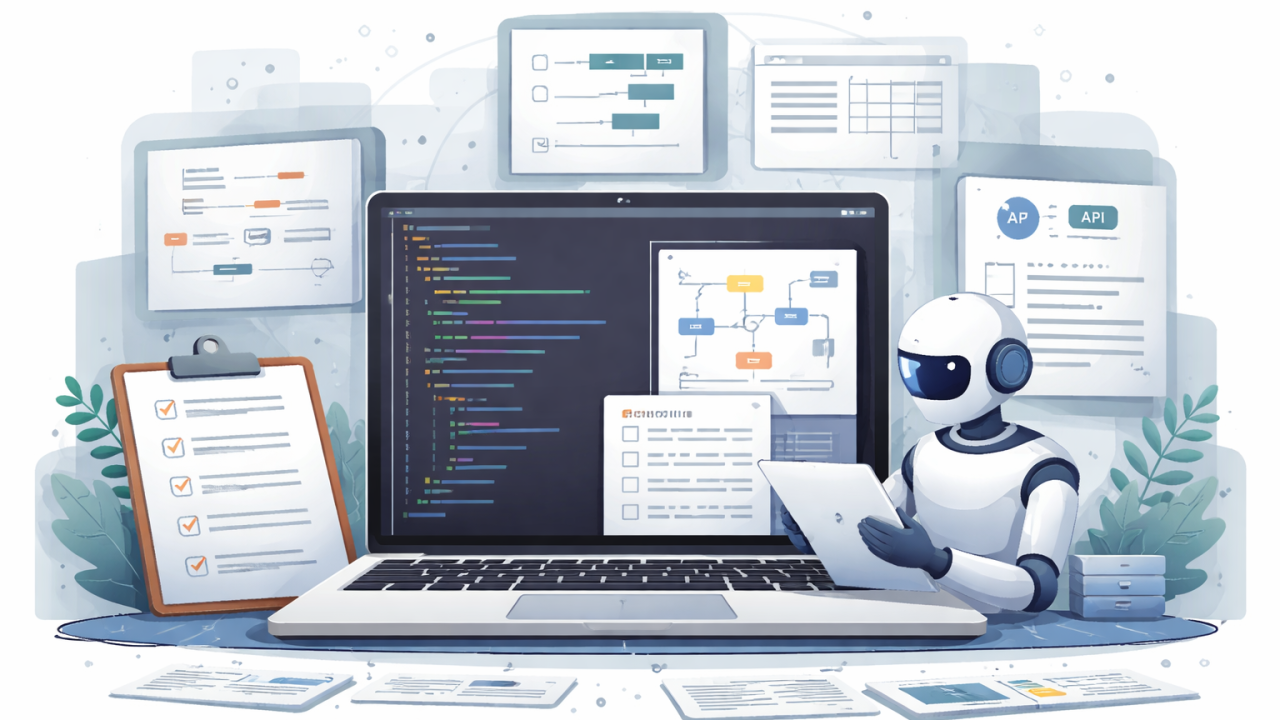
Documentation in AI-Augmented Development
Documentation is becoming context infrastructure: the shared memory and verification surface that helps humans and AI agents build coherent systems.
From Project Artifact to Context Infrastructure
Introduction
As AI-augmented development becomes more common, many discussions still revolve around prompts. That is understandable. A good prompt can improve direction, reduce ambiguity, and produce better output. But in real software projects, prompt quality is only part of the picture.
The stronger determinant is context.
AI systems do not operate in a vacuum. They perform better when they have access to clear architecture, precise terminology, implementation constraints, acceptance criteria, examples, and verification mechanisms. In that environment, documentation is no longer just a passive artifact created after the real work is done. It becomes part of the delivery mechanism itself.
In other words, documentation is evolving from project memory into context infrastructure.
From Prompt Engineering to Context Engineering
The popular conversation around AI development often begins with prompt engineering. That framing is useful, but limited. In practice, software delivery depends less on a single cleverly written prompt and more on the quality of the information environment surrounding the model.
Context engineering is the deliberate design of what information the model receives, when it receives it, and in what format.
A good prompt cannot compensate for missing architecture, unclear requirements, inconsistent vocabulary, or absent validation criteria. In software engineering, correctness does not emerge from phrasing alone. It emerges from constraints, interfaces, responsibilities, dependencies, and tests. Documentation is one of the main ways to make those things explicit.
Documentation's New Role
In a traditional workflow, documentation is often treated as a secondary output: something useful for onboarding, audits, handovers, or long-term maintenance. In AI-augmented development, that view is too narrow.
Documentation now serves multiple active roles at once. It acts as project memory. It captures business intent. It defines architectural boundaries. It clarifies how components interact. It preserves domain language. It explains why certain decisions were made. Most importantly, it gives both developers and AI agents a structured basis for reasoning about the system.
That makes documentation a bridge across business intent, architecture and design, implementation, and verification.
Documentation Before Implementation
One of the most effective patterns in AI-augmented development is to produce key documentation before implementation begins.
That does not mean writing large, ceremonial documents. It means preparing a minimal but high-value set of artifacts that reduces ambiguity before code generation starts: implementation plans, architecture notes, interface contracts, domain rules, acceptance criteria, test scenarios, and deployment or operational constraints.
This is where documentation begins to function as an engineering control rather than a project decoration.
Tests as Executable Documentation
A test is not only a quality gate. It is also a precise behavioral statement. It describes what the system should do in a form that can be verified automatically. That makes tests one of the most valuable forms of AI-facing documentation.
Unlike high-level prose, tests leave less room for interpretation. They tell both the developer and the model what must hold true. They turn requirements into observable behavior. They also expose contradictions between what the team says it wants and what the system is actually expected to do.
Why Format Matters
Content matters, but format matters too.
In AI-augmented development, documentation format becomes an engineering decision. The best format is not necessarily the one that looks the most polished in a meeting. It is the one that preserves meaning, reduces ambiguity, and is easy to consume, update, retrieve, and transform into usable context.
Markdown is easy to version, diff, embed, and summarize. Mermaid diagrams combine visual expressiveness with textual portability. OpenAPI, JSON Schema, YAML configuration, and contract definitions constrain interpretation more tightly.
flowchart TD
  Intent[Business intent] --> Context[Context artifacts]
  Context --> Team[Delivery team]
  Context --> Assistant[AI assistant]
  Assistant --> Change[Generated change]
  Change --> Verification[Tests and review]
  Team --> Verification
Diagrams as Context Compression
A good diagram can show flow direction, ownership, dependencies, boundaries, and lifecycle much faster than prose. This matters in AI-augmented development because a diagram can serve both as a human alignment tool and as a context artifact for the model.
The point is not that diagrams replace text. Poor diagrams can be vague, decorative, or misleading. Diagrams are powerful when paired with narrative explanation and concrete implementation context.
Better Collaboration With Business Analysts
AI-augmented development increases the cost of ambiguity in requirements translation. If the original material is vague, the developer must first normalize it before a coding agent can use it effectively.
Clearer terminology, explicit mappings, decision records, examples, edge cases, and tabular business rules stored in machine-friendly formats improve the handoff across analysis, design, and implementation.
Risks and Failure Modes
More documentation does not automatically produce better results.
Stale documents can inject obsolete assumptions. Duplicated sources can create uncertainty about which artifact is authoritative. Beautiful diagrams can create false confidence while hiding missing details. Auto-generated documentation can produce volume without clarity.
Documentation quality matters more than documentation quantity. The most useful documentation is current, scoped, explicit, close to implementation reality, and aligned with verification.
Conclusion
AI-augmented development is often described as a prompting problem, but that is only part of the story. In real delivery environments, the stronger issue is context.
Documentation is central to that context. It can function as memory, alignment, specification, and verification support. It can reduce ambiguity before implementation starts. It can improve collaboration between analysts, architects, developers, and AI agents.
Documentation now deserves to be treated as a first-class engineering concern. It is no longer just a record of what was built. Increasingly, it is part of how software gets built in the first place.