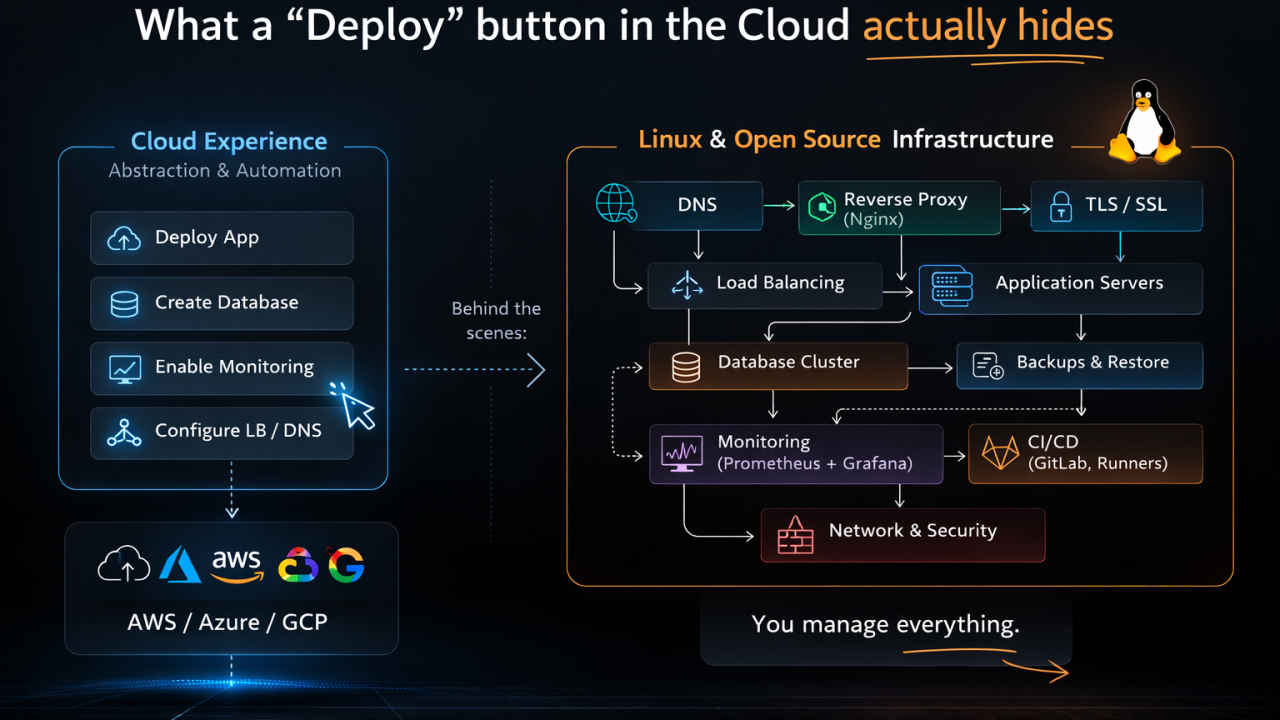
What a Deploy Button Actually Hides
A deploy button hides DNS, TLS, runners, backups, rollback paths, monitoring and operational risk. Owning the full chain changes architecture thinking.
Many Engineers Work With the Cloud
Fewer Have Had to Build the Same Reality From the Linux Level Up
In enterprise environments, complexity is distributed across teams: networking, security, platform engineering, databases, monitoring, and operations.
That model makes sense. It is how modern systems scale. But in a self-managed stack, that separation disappears.
You are responsible for DNS, reverse proxies and TLS rotation, CI/CD pipelines and runners, network segregation, deployment strategy, backup and restore, monitoring, security hardening, and continuity when something breaks.
This is where architecture changes meaning.
It is no longer just about drawing boxes and arrows. It is about understanding the real dependencies, the weak points, and the operational cost of every design decision.
In my own lab, I run a complete environment with self-hosted GitLab, custom CI/CD, automated VPS deployments, monitoring, backup flows, reverse proxy configuration, and database deployments designed for continuity.
Building it properly took time. A lot of time.
Not only to make it work, but to make it predictable, maintainable, and safe.
Because once you own the whole chain, you start seeing what managed platforms usually abstract away: certificate lifecycle, rollback paths, restore confidence, runner discipline, hidden dependencies, resource bottlenecks, and the cost of every shortcut.
That effort teaches something abstractions alone rarely teach: where systems are fragile, where complexity really lives, and where performance, security, and reliability actually come from.
Enterprise work teaches coordination across teams. Running your own infrastructure teaches direct responsibility for the entire chain.
Both perspectives matter.
And together, they create better architects.