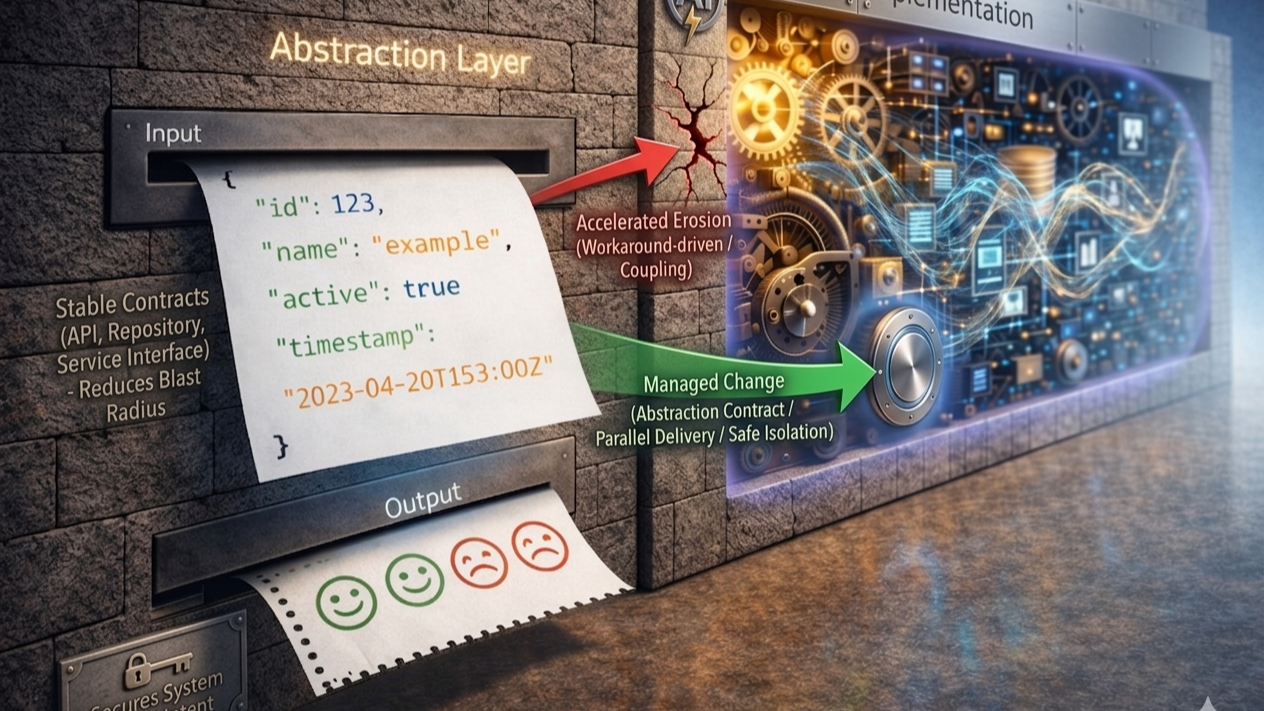
Why Abstraction Matters in AI-Augmented Development
AI can generate code quickly, but abstraction keeps change controlled, contracts stable and generated output aligned with the wider system.
There is a growing belief that AI reduces the need for careful software design. If implementation becomes cheaper, some assume structure matters less.
I believe the opposite.
The more software development is accelerated by AI, the more important abstraction becomes.
AI can generate code quickly, but speed alone does not produce a durable system. What matters is whether the code can be integrated safely, reviewed efficiently, replaced without widespread breakage, and evolved as requirements change.
Faster Implementation Can Mean Faster Erosion
Poor structure has always created long-term costs. In AI-augmented development, the same problem can appear much more quickly.
When implementation becomes cheaper, teams naturally produce more features, services, integration points, experiments, and partial solutions in less time. Without clear boundaries, this does not create maturity. It creates accelerated erosion.
The cheaper the code becomes, the more expensive the poor structure becomes.
Abstraction Creates Safe Boundaries
Abstraction matters because it separates concerns and defines stable contracts.
A well-designed interface, a clear application service, or a domain boundary isolated from infrastructure reduces the blast radius of change. This is especially important when AI is involved, because generated code often solves the local problem without preserving the system's global design intent.
A model can generate a controller, repository, mapper, or service very quickly. But unless architectural boundaries are explicit, it can also mix business rules into transport logic, leak persistence concerns into the domain, or couple application flow directly to a provider or framework.
Abstraction creates safe boundaries for implementation. It defines where code belongs, what a component is allowed to know, and how change should be absorbed.
Plug-and-Play Needs Strong Contracts
One of the clearest practical benefits of abstraction is plug-and-play design.
If a component depends on a contract rather than a concrete implementation, the consumed service can change without forcing a redesign across the rest of the application. A production provider can be replaced by a mock during development, by a sandbox during integration testing, or by another external service in the future, while the contract remains stable.
Plug-and-play is only credible when the contract is stronger than the implementation.
Abstraction Improves Work Distribution
When a contract is defined early, development does not have to stop while one dependency is still being built. A temporary mock can be introduced behind the same contract, allowing other components to continue in parallel. The UI can be developed before the real backend is ready. One service can integrate against a simulated provider while another team finalizes the actual implementation.
A stable contract allows implementation to lag behind integration without blocking delivery.
Practical Example: Migrating From Legacy Services
If an application depends directly on legacy integration details, every migration becomes invasive. Transport specifics, authentication details, payload peculiarities, and error handling rules leak into multiple parts of the system. Replacing the service then becomes expensive and risky.
If the application depends on an internal contract, the legacy provider can sit behind that contract as one implementation while the newer service is introduced as another. The rest of the application continues to depend on the same abstraction. Migration becomes incremental rather than disruptive.
Practical Example: Evolving Toward Distributed Caching
A system may begin with no distributed cache, then add a simple abstraction, then introduce an in-memory implementation, and later evolve toward Redis on Kubernetes. If consumers depend too early on a concrete caching technology, that evolution becomes expensive.
A better approach is to introduce a cache contract early. Consumers depend on the contract, not on Redis itself. The implementation can start simple and evolve as operational maturity increases.
This is not overengineering. It is incremental architecture.
Architecture, Patterns, and DDD Still Matter
Architecture is not the same thing as abstraction, and patterns are not the same thing as architecture.
Abstraction gives us boundaries and replaceability. Patterns give us proven ways to structure recurring problems. Architecture defines the system-wide direction and the responsibilities for dependencies. DDD helps keep the model aligned with business meaning instead of technical noise.
That combination becomes more important, not less, when AI is involved.
Pragmatism Still Matters
None of this means every system needs maximum layering, every pattern, or abstraction everywhere.
Good abstraction is justified by expected change, complexity, risk, or the need for replaceability.
Bad abstraction hides simple logic behind ceremony.
AI Is Not a Remedy for Everything
AI does not remove the need for engineering judgment. It increases the value of it.
Used well, AI can reduce mechanical effort and create more space for better decisions: clearer contracts, stronger reviews, better tests, and fewer shortcuts. That is where its real value appears.
AI works better with structure. So do teams.
AI Can Accelerate Hacks as Easily as Quality
Under delivery pressure, teams sometimes build solutions that remove the visible symptom but leave the root problem untouched. The result may work temporarily, but it often introduces extra coupling, duplication, hidden complexity, or another fragile exception path.
Because code is easier to produce, it is also easier to generate another patch, another conditional, another wrapper in the wrong place, another local fix that avoids deeper correction.
A workaround that survives long enough often becomes accidental architecture.
Smaller Modules Are Easier for Humans and AI
Large systems contain too many details, exceptions, dependencies, and historical decisions to be held equally well in every implementation step. When a module is too broad, both humans and AI are more likely to miss constraints, misunderstand intent, or introduce local fixes that damage global consistency.
Smaller modules are easier to understand, review, and evolve. The implementation can stay local. The contract can stay global.
Conclusion
In AI-augmented development, abstraction is not there to make software look sophisticated.
It is there to keep change controlled, contracts stable, teams unblocked, and solutions aligned with the real problem.
AI can generate code. But abstraction is what allows that code to participate in a system without weakening it.